18 April, 2009
Nice Stash!
I suppose that every knitter buys yarn differently. I have marveled at personal stashes that were the knitting equivalent of a home LYS, custom shelving full of wool, home yarn studios and walk-in fiber rooms. I feel an initial twinge of envy when I see such things but then I remember how I buy yarns and why it suits me.
Most obvious I suppose is that my yarn budget is not six figures… or five… or four, we’ll call it modest. One might think that I do a great deal of planning like “once I have enough money I need “x” amount of yarn for “x” project”. That would seem practical but I also have my whimsical, flighty inner child with which to contend. That side talks to me in space-cadet terms; it says things like “soft”, “shiny”, “fuzzy”, and “that’s the color of moonbeams on Datura flowers”. Yeah.
I might add that this phenomenon hits me when I forget to pack the shopping list that my practical side penned in green ink on a yellow mini Post It note and I find myself dumbstruck in my LYS (which mind you, is about an hour and a half away from home).
All is not lost and certainly not useless, these purchases with no intent (other than their sensuality), become bits of inspiration. I have no idea what I will knit with them initially and it leads me to ponder them, examine them and await that serendipitous moment where a couple balls of airy mohair become a finished piece of knitting. It keeps me going and I wouldn’t change a thing.
love,
Terry
P.S.
Just so you know if I win the lottery (if I ever actually play the lottery), I’ll probably buckle and build a fiber studio but it doesn’t mean I appreciate you any less.
10 March, 2008
FO: Liesel Scarf
09 March, 2008
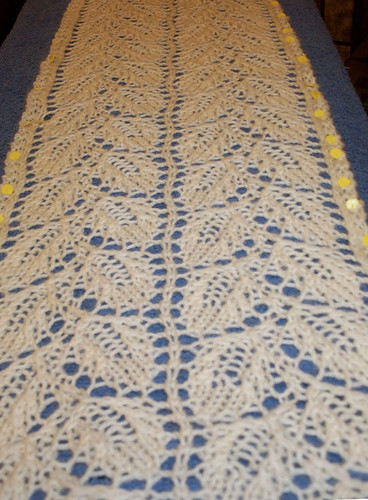
Liesel Scarf
Don't think it was all wine and roses, Liesel and I started off on the wrong foot. This was my first "big boy" pattern, life before Liesel was all knit, purl and not much else. I was determined to get through this however. I started Liesel on some aluminum (I don't like metal), straights which were the only thing I had at the time in that size. What resulted was bursts of progress and then a mistake of some sorts would send the thing flying into the frog pond. "Great" I thought, I would have to lock myself up like a hermit if I were to ever make some serious progress with this (that's when I learned about using a lifeline). Then something new came along to halt this project, I ordered my KnitPicks Options Interchangeable Harmony Wood Circular Knitting Needle Set, surely after frogging it yet again I could wait until my fancy new needles arrived and dump those aluminum straights. Well, as it turns out the size I needed for the Liesel Scarf was in place and I was happily knitting away when I found there was a defect in one of the tips which snagged unrelentingly at the wool. So another wait was eminent, thankfully Knit Picks took care of the problem in no time at all. Finally, with no more excuses, Liesel was under way toward the end of February. As I type this entry, it is done. Liesel is blocking on my ironing board right this very moment, as a matter of fact, my hands are still pruny and smell of wool wash.
- When dealing with patterns composed of various stitches/techniques, keep count of your stitches! I double checked at the end of each row that I had the correct number on the needles. I also went through each row of the pattern and wrote down the number of stitches that should be left on the needles at completion of that row. This made life so much easier.
- I made myself a large-type printout of this pattern in an easy to read font with lots of space between rows. I put said pattern on my clipboard and was ready for action (this stopped me from knitting half of row 6 and finishing it with half of row 7).
- SK2PO means Slip One Stitch, Knit Two Stitches Together, Pass Slipped Stitch Over
- Using a lifeline is as vital as the name suggests. I used a length (not too short or it may pull through) of black cotton embroidery floss after each pattern repeat. This way if I had to frog, I only had to rip down to the string which also let me know how my stitches should go back on the needles. I used embroidery floss as it is less likely to get in the way when knitting the row above it, embroidery floss also doesn't (shouldn't) shed, getting odd colored fibers into your work. Think about it, why would you want to frog an entire project when you could get away with frogging only a couple of rows?
- The felted join is a fabulous way to start a new ball (assuming that the yarn you are using can be felted)
- Knitting the tail of your Cast On into your work with the first couple stitches (no need to weave in one end at least).
- Duplicate Stitching as a means to neatly weave in the remaining yarn end(s).
- And finally, I've learned that my ironing board isn't such a great blocking board. I really need to come up with something different.
All in all I am very happy with my Liesel scarf. This is the first project I am super proud of. I will post some specs as well as pictures of the finished scarf soon. Also, to my fellow newbie knitters; dive in the deep end. I highly recommend it. Choose a project that seems just a bit too advanced for you and get yourself through it no matter what. I guaranty you will be pleased with the lessons you've learned.
24 January, 2008
Counting My Chickens Before They've Hatched
13 January, 2008
Yarn Review: Lion Brand Jiffy
The Facts
- Brand: Lion Brand
- Style: Jiffy
- Color: Grass Green
- Material: 100% Acrylic
- Weight: Bulky
My Take
I did not like working with this yarn at all. First off, I chose this one from the isle of plastic yarns at Wal Mart because it seemed to have the least offensive texture. They had Lion Brand Homespun (which I *gasp* think is rather nice for a 100% Acrylic yarn), but I wanted something smoother for practice since Lion Brand Homespun is not so hot in the stitch definition category. I didn't notice that Jiffy is actually considered a Bulky Weight yarn, and looking at it now it does not seem terribly different from a Worsted Weight. I also didn't notice that this yarn is described as having the look of mohair (how soon would I find out). As I cast on, the yarn already began to "bloom", leaving my with a faux-mo mess. I persisted and made up my fuzzy swatches. The yarn was a pain to work as splitting was a consistant problem on sharp needles and more gently tapered needles. Over all, I felt that everything about working with Lion Brand Jiffy was sloppy and I would not use it for a project (or even for practice again).
Pros
- Large range of solid and multi-colors
- Soft feel (though not as soft as mohair)
- Reasonably looks like mohair (though I don't think it would fool many)
- Widely Available
- Inexpensive
Cons
- Splits and snags easily
- Yarn "blooms" quickly and distorts stitches
- Yarn also sheds rather easily
Will I Purchase it Again? No.